
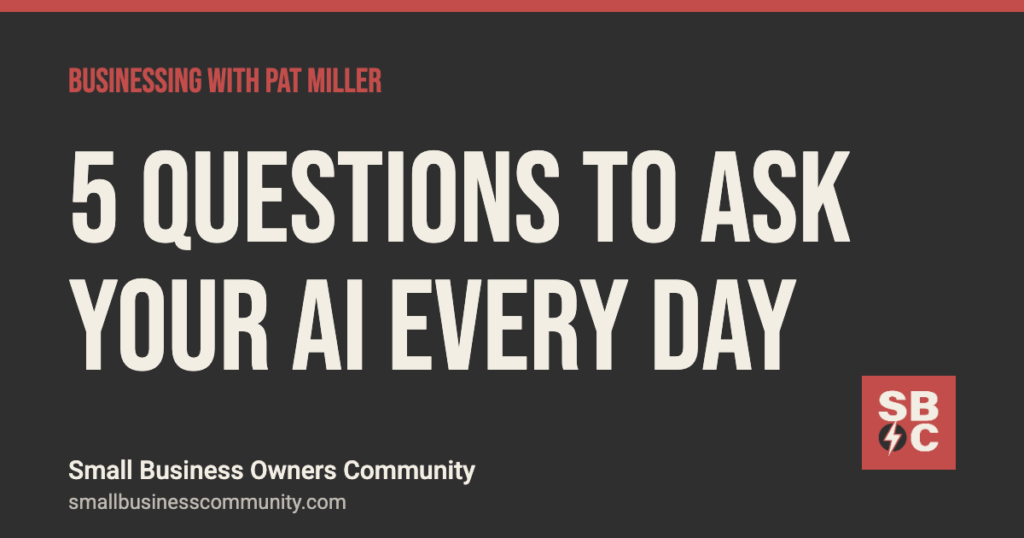
The five questions to ask your AI every day are: what am I missing, what would you do differently, what’s the fastest path to revenue this week, what am I spending too much time on, and where am I lying to myself. Ask those five with real context about your business and you stop using AI as a search box and start using it as a partner.
Asking AI to write a caption or summarize an email is fine. It’s also a tiny slice of what the thing can do. The gap isn’t the technology. The gap is the quality of the question.
What should you ask your AI every day?
Keep this list somewhere you can see it.
- What am I missing?
- What would you do differently?
- What’s the fastest path to revenue this week?
- What am I spending too much time on?
- Where am I lying to myself?
None of them ask for a deliverable. That’s on purpose. Every one of them asks your AI to think about your business the way a sharp partner would, and every one of them only works if you give it the real situation first. Dump in the pricing decision, the hiring problem, or the customer who stopped answering, and then ask.
How do you get AI to find your blind spots?
“What am I missing?” is the one nobody asks, and it’s the one that pays. You’re inside your business, so you have blind spots by definition. They’re built out of assumptions you made so long ago you forgot they were choices. An outside perspective that has read a big chunk of everything can spot the thing you stopped seeing in year two. Give it the full picture, not the sanitized version, and sit with the answer instead of arguing with it.
“What would you do differently?” is the same setup with a sharper edge. The wording matters. “Is this a good plan?” gets you a compliment, because that’s what the question invites. “What would you do differently?” forces alternatives onto the table. You want them in front of you before you commit money and months to the first idea you had.
How can AI find the fastest path to revenue?
Ask for this week, not this quarter. The time constraint is what makes it useful, because it kills every answer that involves rebranding, building a funnel, or waiting on a website. Give it your real assets: your customer list, your services, and your capacity right now. What comes back is usually unglamorous and obvious in hindsight. Call the twelve clients who bought last year and haven’t been back. Package the thing you already do into a smaller offer. Raise the price on the service you’re underwater on.
The time question is the partner to that one. Describe your week honestly, including the parts you’d be embarrassed to say out loud, and ask what should come off your plate. You can’t hand off what you haven’t named, and once the blur gets broken into a list, three or four items are always obvious candidates for somebody or something else.
Will AI tell you the truth about your business?
It will if you ask for it. “Where am I lying to myself?” is the uncomfortable question and the most valuable one, because AI doesn’t work for you, doesn’t need the relationship, and won’t soften the answer to keep the peace. Your spouse doesn’t want to fight about it. Your team can’t afford to say it. Your friends want to be supportive. So the thing everybody can see stays unsaid, and you keep pouring money into the offer that never worked or holding onto the client who costs more than they pay. Ask directly, give it the numbers, and let it say the thing.
Then push. When the answer comes back, don’t take it and close the window. Ask why that one first, what would make it fail, and what it would need to know to be more confident. The second and third exchange is where the useful stuff lives. The first answer is just the door.
Questions owners ask
Does it matter which AI I use?
Less than you’d think for these five. Any capable assistant will handle them. What matters more is whether it can see your real files and numbers, because that’s the difference between advice and analysis.
How much context should I give it?
More than feels comfortable. Revenue, customer count, what you sell, what’s working, what isn’t, and what you’ve already tried. The quality of the answer tracks almost directly with the quality of the setup.
Won’t it just tell me what I want to hear?
It will if you ask leading questions. “Is my plan good?” invites a yes. “Where am I lying to myself?” doesn’t. Ask for the criticism explicitly and you’ll get it.
Should I trust the answers?
Treat them like advice from a smart friend who doesn’t know your industry perfectly. Useful and worth considering, but not gospel. You’re still the owner and you still decide.
Pick one question today, not all five. Give your AI real context about your business, ask it, and then ask two follow-ups. That’s fifteen minutes. If you get one thing you can act on this week, go do that thing.