
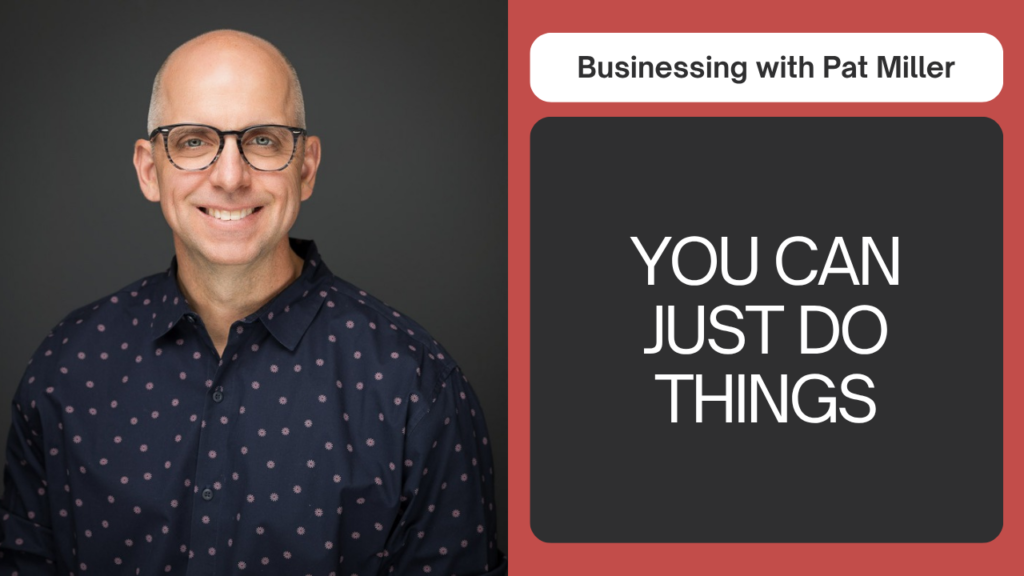
There’s something on your to-do list that hasn’t moved in weeks, and it isn’t because you’re lazy. Five faces of inaction keep small business owners stuck, and today Pat names all five: high standards, worrying what people will say, plain old procrastination, money ghost stories, and hunting for validation before you move. Then he hands you the one rule that beats all of them. You can just do things.
Michael Rampolla of Fortum Advisors joins to talk conference strategy, how to actually get an R on your I, and why the follow-up plan you build before you go is the whole ballgame. Idea Slam takes on the hardest thing in small business, which is saying the price out loud and then shutting up. And the AI story of the day is show and tell. Pat spent two days with Claude cleaning up six years of conflicting information about his business online, and he walks through what changed and how to run the same thing on yours.
Businessing is the daily live show where small business owners figure out what to do next. Hosted by Pat Miller, founder of the Small Business Owners Community: owners only, nobody pitching, $9 a month.
In this episode
- 00:00 The five faces of inaction, and the thing on your list that never moves
- 01:37 High standards, or waiting until the work is flawless
- 02:01 What will people say
- 04:12 Procrastination, because hard work is hard
- 04:58 Money ghost stories, and how they stop you on both sides
- 06:44 Hunting for validation before you act
- 07:26 You can just do things
- 09:41 Foureva Media
- 11:17 Michael Rampolla on conference strategy and the R on the I
- 15:58 Working the elements: Coaches Row, meals, and breakfast meetings
- 19:12 Building the relationship without coming off as a creep
- 20:46 The number one conference failure is no follow-up plan
- 26:52 Idea Slam: you said the price, now stop talking
- 29:29 First to speak loses
- 30:35 Minuteman Press of Brookfield
- 32:34 AI story of the day: six years of conflicting information online
- 35:44 What Claude did to 280 blog posts, the RSS feeds, and the invisible stuff
- 40:42 How to run this on your own business
- 42:00 SBOC news and the conference is seven days out
Resources mentioned
- Michael Rampolla, Fortum Advisors
- SBOC26 Conference, September 15-17 in Brookfield
- Foureva Media
- Minuteman Press of Brookfield, 20% off your print order through November 13
Full transcript
Pat Miller: Good morning. It is Tuesday, September eighth, and we are businessing. Nobody taught you how to run a business, yet look at you. You’re running one anyway. This is the daily show where small business owners figure out what to do next. I’m Pat Miller, founder of the Small Business Owners Community, and on this show, we’ve got a couple of things today.
Pat Miller: We’ve got a guest, Michael Rampolla from Fortum Advisors. We’re gonna talk about an idea slam today. You know when you ask someone for money, and you tell them how much it is, and then you just keep babbling? That’s costing you cash. We’ll talk about how to actually ask for money. AI story of the day is show and tell today.
Pat Miller: I spent two days this weekend working with Claude, totally transformed the business. I’ll show you the receipts in a minute. Good morning, Rebecca, great to see you, and Michael, of course, great to see you here. When you log in, say good morning so we know you’re here. We can give you some free publicity.
Pat Miller: Sponsored this morning by Foureva Media and Minuteman Press of Brookfield. Abby Miller, good morning. Great to see you. Let’s get into it. The big story of the day, the five faces of inaction. In other words, why aren’t you doing what you know you need to do? If you look on your to-do list, there is something that’s just been sitting there.
Pat Miller: You need to update the page, you need to calculate the numbers, you need to do the thing. Yet it sits there like a rock in your shoe, and you just can’t bring yourself to get it done. Why is it? Five faces of inaction. These might be the reasons why you’re not getting it done. Good morning, Alex. Great to see you on YouTube.
Pat Miller: Thanks for tuning in. First one is high standards. I’m gonna do a thing, I need it to be great. Why? Because I’m great. Everything I do is great, so I can’t do anything that is anything less than ultra-premium, amazing quality. When you have those high standards, really kinda stops you from getting anything done.
Pat Miller: You can’t just get something done and get it off. You have to take the time to make sure it’s absolutely flawless, and that’s holding you back, and it’s slowing you down. Teresa, good morning. Great to see you. The second one, and it kind of goes along with the first one. What will people say? If I put up a webpage, if I put up a blog, and it’s A but not A plus, what if people say things?
Pat Miller: I can understand where that’s coming from. I don’t like getting judged either. We all get judged, so we wanna over-engineer our work to make sure it’s flawless. But here’s the thing. Two things, really. Let’s be real. You could release today, I don’t know, Pink Floyd’s Dark Side of the Moon, greatest album there ever was.
Pat Miller: I will not listen to your critiques otherwise. Let’s say you could release Pink Floyd’s Dark Side of the Moon today, 80% of the world would hate it, and 80% of the world has a microphone to go onto an internet and tell the world they hate it. It doesn’t matter. You’re not creating any content for 100% of the world.
Pat Miller: You’re creating content for your corner of the world, and the only thing that matters is what they say. There’s way more people that hate you than will love you, and now that everyone has a platform, it’s gonna be nothing, nothing but hate that comes back at you. It doesn’t matter. You’re not for those people anyway.
Pat Miller: And to further drive home this point, not only will the majority of people hate you, and there’s nothing you can do about it, it’s that the majority of the majority of the people not only will hate you, they’ll never even know it exists. Do you know how hard it is to get someone’s attention today? It’s impossible.
Pat Miller: Google and Facebook make gazillions of dollars allowing you to pay to try to get someone’s attention. So to create something organically and put it out in the world and worry that here comes this mountain of hate is make-believe. No one’s gonna even notice it’s there in the first place. And then, like I say, the vast majority of the people are going to hate it to begin with.
Pat Miller: Happy Tuesday. Put on your big boy pants and get over it. Good morning, Rebel. Thanks for tuning in on Instagram. Great to see you. Face number three. If you’re just tuning in, we’re talking about the five faces of inaction, the reason why we don’t get stuff done. Procrastination. This seems obvious. Hard work is hard.
Pat Miller: I don’t wanna work hard. I wanna look at Twitter. I wanna watch YouTube while I eat. I’d rather take a nap because naps are great. I’d rather not do hard work because hard work is hard, so we procrastinate. It’s something we all do. The thing about procrastination is you have to call it out when you catch yourself doing it.
Pat Miller: I could knock this task out, but for some reason I’m not doing it. Why? ’Cause it’s hard. Okay, that’s probably why I’m not doing it. Pretty obvious, but something that should be called out. Face number four, money ghost stories. There are two kinds of money ghost stories, and it cuts both ways. I can’t do this video that I wanna do, or I can’t make this thing happen until I get new lights, until I upgrade my camera, until I get new clothes, until I get my hair replacement therapy, I wish.
Pat Miller: Until whatever. And I don’t have the money for that yet, so I can’t. We use money as stop sticks. And then on the other side, we overestimate how good we are at generating revenue. So we overestimate how much things are gonna cost, that slows us down. Then we underestimate how much work it’s gonna take to make the money in the first place.
Pat Miller: Good morning, Barbara. Great to see you. Meaning, “Oh, yeah, you know what? I think I could sell 10 of those packages at $1,000 apiece.” Not if you’re not out there working it every day, you’re not going to. Because you have a business that’s open, you know how hard it is to sell anything to anyone right now. It’s really hard.
Pat Miller: You’re not gonna coast your way into making money that you wanna make. So we don’t think deeply enough about how much it costs to make some money, and then we also allow the expenses to stop us from taking action in the first place. So these money ghost stories stop us on both sides. Then the fifth face of inaction, the thing that really slows us down.
Pat Miller: Before we go out and do something, we seek a bunch of validation. “Ooh, you know what? I better do a bunch of research. Boy, I wonder if a study’s been released on this. Who on YouTube is already doing this so I can go see how they do it? You know what? I need to do a bunch of qualification interviews. I better sit down with 10 of my great clients like Barbara Fausett.”
Pat Miller: Good morning, Barbara. Welcome to the show. “And I better ask Barbara all about it because if Barbara doesn’t like it, I shouldn’t move for…” We worry so much about the validation that everyone’s gonna tell us, “That’s a great idea. You should do it.” No. No. It makes sense to talk to your clients, sure. It makes sense to do research.
Pat Miller: But when you do so much of it, you can’t act. You forget the one rule of doing business in 2026. You can just do things. You can just do things. Anything. Do it. Try it. If it doesn’t work, stop it. If it works great, double it. You can just do things. You don’t need permission. You don’t have a boss. You’re the boss. That has to be said to people that came from corporate.
Pat Miller: It has to be said to people that are worried about what other people think. It has to be said to those of us that just don’t move fast enough. You can just do things. Five things, five reasons why we put out the stop sticks and we don’t get stuff done. You and I both know that if you just closed your browser and got off social media, you could do whatever that thing is in less than an hour.
Pat Miller: And if you did that thing and got out of your head, you’d be further down the road. But we don’t because of feelings. But feelings don’t pay the rent. Doing the work does. Get through those five faces of inaction, and you’ll move further down the road. Idea Slam is coming up. We’re gonna talk about when you ask people for money, and then they haven’t given you an answer yet, and how we sabotage ourself in between those two things.
Pat Miller: I’m also going to do the AI story of the day today as show and tell, ’cause I worked with Claude’s Fable 5.1 for two days over this weekend. I went nuts and fixed a major architectural problem in my business, and I’ll show you what I did ’cause I’m pretty happy about it, and you should probably be doing it too.
Pat Miller: Michael Rampolla from Fortum Advisors is standing by. We’re gonna talk with him about getting the most out of the SBOC Conference, which is one week away. I’m not freaking out. You’re freaking out. We’ll talk to him after we talk about Foureva Media. Foureva Media, sponsor of the big stage at SBOC ’26. So if you’re coming, you’ll see the big, beautiful stage courtesy of them.
Pat Miller: And what they do well is they help business owners get surrounded by people that lift them up, help you strengthen your brand, grow the business, and get into a circle that will move you forward. Because if you’re not in the right circle, they’ll actually slow you down. You get in the right circle, it’s gonna speed you up and make you build a bigger, better business.
Pat Miller: One thing that they’ve realized is that the majority of business owners don’t need more information clogging their head. They need practical strategy, and they need accountability. So surrounding you with the right people and holding you accountable to the stuff that you know you need to be doing, that’s how you can move forward.
Pat Miller: To learn more, scan the QR code or go to fourevamedia.com, and you can check out their podcast while you’re there as well. Foureva Media, change your circle, change your business. Looking forward to seeing Jamar here in the Brookfield area next week as they take the Foureva Media stage.
Pat Miller: Kim Yancey, what a good guy. Welcome, Kim. Great to see you here on Businessing with Pat Miller. Long time. We have not caught up in forever. I would love to talk with you. Deborah, welcome to the show as well on Instagram. Let’s bring out today’s guest. We’re gonna talk about getting the most out of a conference and welcoming in Michael Rampolla, our man out in the field. Michael, good morning, sir. How you doing?
Michael Rampolla: I am well. How are you, sir?
Pat Miller: I’m great. So if someone doesn’t know about Fortum Advisors, tell them all about who you are and what you do.
Michael Rampolla: Sure. Fortum Advisors, we are a business advisory firm. That means we work with business owners, help them grow, scale, and optimize. And more importantly, at the end of the day, the number one thing we do is help you identify the right problem to solve.
Pat Miller: Problem to solve this week is that SBOC 26 is one week from today. We’re gonna bring 125 entrepreneurs all into one room. And why is this on your mind today? How to get the most out of a conference. Why did this come up for you?
Michael Rampolla: Thanks for asking. So first of all, obviously, yes, we’re getting ready for that conference in particular, and I advise many clients on conference strategy, and most people don’t think about that that’s even a thing, right? I remember the time I learned that menu engineering is a thing in restaurants. I’m like, “That’s a thing?” And then when I realized that’s a thing, I’m like, “Oh, I see it everywhere.” Conference strategy, most people don’t think it’s a thing. Once you realize it’s a thing, you see who does it really well. So that’s what’s on my mind, is the clients who I’ve advised who have gone into a conference generally to attend, and those that have gone in with a strategy, and how they have a very different, not only experience during the conference, but results afterward.
Pat Miller: And let’s build that then. So SBOC 26 is Tuesday through Thursday next week. Are you advising people to start with a goal, like, “I wanna leave with three new deals,” or, “I wanna make five new power partnerships”? How do you help them think about what they’re trying to get out of a conference experience?
Michael Rampolla: That is the number one thing. The number one thing is identify why you’re actually doing this, and therefore, what’s the measurable goal that you’re gonna be able to get out of it? Some people do attend conferences like this, and the thing they really wanna get out is spending time with people and having the experience, and the get out is really just the time there, and that’s fine. If that’s your goal, then you can have a plan to achieve the best possible experience during the conference. Many of us are investing in a conference and expecting an R on that I. And if you want an R on the I, you need to identify what the R is. Otherwise, you’re gonna have a great week and no R.
Pat Miller: We gotta have an R on the I. The R on the I is fuzzy, because the R on the I could be learning something you didn’t know that’ll help you build a better business. But more importantly, most times it’s making new relationships that you didn’t have before. So how do we quantify the R on the I?
Michael Rampolla: So ideally, we’re gonna link the conference R to your business R. Close more deals, increase revenue, right? Maybe it’s find efficiency. Maybe it’s I need to develop a new relationship because I wanna go after this business that I can’t get on my own. So there’s lots of things that you might be trying to do with your business, and the particular conference you’re attending might be your way to get there. I was advising a client last week who’s attending the world’s largest fully irrigated farm show. That’s a thing, next week. And I said, “What are we hoping to get out of this?” He goes, “New dealer relationships.” I said, “Okay, so what’s our strategy? What’s the value of that to the business, and how are we gonna get there?” So it doesn’t matter what kind of a conference it is, really doesn’t matter what your goals are. If you’re investing for the return, we gotta be able to link those two together, and then we build the plan to get there. And it really comes down to what’s my goal and what’s my opportunity. Every conference has an agenda. You’ve got the people who are gonna be there. There’s the elements of a conference. And you take the elements of a conference, and you say, “How do I use the elements to achieve my goal?” Because the conference organizer, Pat, he has a goal, and he has organized the elements of his conference to achieve his goal. But that same box of Legos can make both the pirate ship and the castle. So if we say Pat’s building a ship and I’m gonna build a castle, I take the exact same elements, and I figure out how to reconfigure them so I can achieve my goals using the same things that the host brought together for me.
Pat Miller: Let’s look at my conference as the example. So let’s pretend that you’re advising Teresa, she’s with us this morning. Teresa is coming to the conference. We’re gonna talk about the Legos I have. I’ve got our open-ended networking conversations during the day. I’ve got a facilitated meet up the night before. We have meals with open seating where you can choose who you sit with. You’ve got Coaches Row. You can sit down with coaches one-on-one. We’ve got happy hours where you can talk up with people. You’ve got where are you gonna sit in the conference room. Are these the kinds of things that you’re thinking about?
Michael Rampolla: All of those things. And Teresa, I believe, was wise enough to grab a table at Coaches Row. So she has already made a significant move in the direction, so therefore I believe one of her goals must be, or probably is, to find new clients. Her goal at the conference is to get all of her eight slots filled, so she has a chance to demonstrate one-on-one the real value of what she can do, and ideally get some follow-on conversations, maybe some business from that. If I was Teresa, one of my major goals at the conference would be ensuring that all eight slots are filled with high-value opportunities. I would walk in with the QR code that’s direct to my booking link, and if I meet somebody who I think I would like to have a conversation with while we’re still here, I would absolutely say, “You know, you should book time. I still have one slot available. Why don’t you grab that slot at Coaches Row, and we can talk then?” I just booked a meeting. You’ve got dedicated time. Now, that’s this conference. My client from last week, I said, “Make sure you schedule lunch with the people you wanna talk to.” He goes, “Well, it’s open lunch, like with a buffet.” I said, “Perfect. Make sure you claim their time.” ’Cause if you don’t claim their time, your competitors will. So get lunch with them in advance. Say, “I’m gonna take you off-site for lunch. The buffet is the buffet. We don’t wanna wait in line. Let me take you out for lunch.” Now, I just claimed an hour of exclusive time that nobody else gets ’cause I claimed it. That’s another example of conference strategy.
Pat Miller: When I used to go to conferences for radio, I would find the people that I liked. I would buy them breakfast. Breakfast is usually not scheduled, criminally under leveraged. And if you tell someone, “Let’s get together for coffee before the day starts,” they’re fresh, you’re fresh, they’re not gonna get interrupted by 82 phone calls. In 20 minutes you can really get to know somebody, so that’s something I used to like to do, and they really have no excuse. I even exercised with people before. Something in the morning always seems to work. So you’re leveraging the things that are on the agenda, and yes, Teresa is full. And by the way, not only do we have Teresa on Coaches Row, Michael Rampolla is on Coaches Row as well, so you can book one-on-one time with Michael. So okay, we are taking advantage of all the stuff that’s there. I wanna ask you a pretty direct question. When you’re talking with someone at the conference or someone at a business event, if you lean in too hard, you’re a creep. We’re not there to convert relationships while we’re making relationships. So how do you convince someone to get to know someone and have an opportunity to continue the conversation without leaning in so much that you come off as a creep?
Michael Rampolla: One of the things that I’ve learned, ’cause that is a balance that we all face in networking in general, social or professional, one of the things that I’ve learned to leverage is leaving part of the conversation out. So when I leave part of the conversation out, that’s my reason to come back to that conversation later. So if there’s something that we’re talking about and I say, “You know, that’s something that we should really follow up on one-on-one.” Otherwise, I might lean in right there, two things, give it all away and have no reason to follow up because I just answered all your questions. Monopolize your time and give up a bunch of my time. So if the goal of the conference is to build new relationships, build those relationships. Relationships exist more often because we talk to each other more than once. So use that as a way to leverage into a follow-on conversation. Now we’re relationship building and not just temporary friend having.
Pat Miller: That helps a lot. Okay, so help us land this plane. We know what we wanna get out of it. We’ve looked over the structure of the conference. We’ve done some proactive scheduling, perhaps. We’ve talked about how to talk with people while we’re there. When the conference is over, how are we moving those relationships forward? How are we keeping things alive once we all leave the hotel?
Michael Rampolla: The number one failure that I see, whatever part of the conference you’re in, whether you’re an attendee, the host, an expo vendor booth, whatever it might be, the number one failure I see is I don’t have the follow-on plan already built. I don’t have the week after the conference already scheduled for how I’m gonna follow. I don’t know who I’m gonna contact, but I know this is the time when I’m gonna contact them. All those meetings I said I was gonna schedule, did I get them scheduled? If you’re an expo, with my fish bowl full of cards, better not be a fish bowl full of cards by Monday. It better be contacts in your CRM by the time anybody else is back at their desk. And if you haven’t blocked time in advance and figured out my post-conference plan to leverage the investment of the conference, here’s where your R never shows up. So often, people do everything to prep for and have no prep for after. They do everything to get ready for, and they have nothing to do with what comes after, and literally, it was a waste of investment. And it’s unfortunate, and it’s solvable. And so we talk about the plan, the conference is a moment. There’s the pre and the post, and you have to build the whole thing together. Otherwise, you’re missing out on what you were really there to do.
Pat Miller: You know, you’ve hit on something here, and this is a huge frustration for me as a conference organizer, that we sell sponsorships. We invite people to come to the conference, and they show up, and they just sit on their phone the whole time, and they don’t engage, and then they leave and think the conference is a failure. Like, no, bro, you didn’t go shake hands and kiss babies and get to know people. You didn’t build these relationships. And I’m thinking out loud, how simple would it be to take our conversation today, turn it into a one-sheet that we send out to everybody coming to the conference. Here’s how to get the most out of it. Would you be okay if we did that?
Michael Rampolla: I would love that. That’s a great idea. That way everybody who’s attending would get that much more value out and would have that much better of an experience, which helps everybody.
Pat Miller: Yeah, I love it. And what’s so funny is that now when I say I, I mean my team, and when I say my team, I mean Claude. Which is pretty much what happens. Claude is now my team. Free space before we let you go, is there anything that we haven’t talked about that you think is important about building a great conference strategy?
Michael Rampolla: Building a great conference strategy is the whole thing. And again, it’s the before, the during, and the after. If I’m gonna have a great experience at the conference, I need to do everything I can to prepare for that and then protect that time. The two things that might derail this whole thing, everybody, is not staying focused on the goal once you’re there. If I’m gonna go meet five new people and everybody I’m talking to is somebody I already know, I’ve lost focus. So having that discipline is how you’re gonna get the activity that gets you the goal. That’s number one. And number two is also staying open to the unexpected. I know I literally just put two things that don’t seem like they are compatible. You can do both, and if you know you’re the I’m-focused-and-I-miss-all-the-open-opportunities person, or I’m typically too open and just let’s see what happens, and I have a great time but I don’t get any value out, you probably know which one of those two pieces of advice is the one you need to grab.
Pat Miller: We get a chance to learn from you a couple of different ways. As we mentioned, Michael is on Coaches Row. So when you get your conference ticket, I think we have like five left, you can book one-on-one time with Michael right on Coaches Row. Also, Wednesday night we’re gonna do something super fun. We are going to do the whiteboard magic with Michael on Wednesday night. So give us an idea what whiteboard magic will be all about, ’cause you’re the wizard of the whiteboard. What are we gonna do?
Michael Rampolla: We’re gonna solve problems live without a net. I mean, it’s Idea Slam with visuals, in a sense, right? The reason we’re adding the visuals is so often when I’m asking people and it comes down to, “Well, what was the most helpful part of this? What changed this for you?” The answer I get back is a version of, “It was so helpful to see it.” So what we will be doing is taking the thing that’s in your head in words or somewhere out there and presenting it back in a way that’s like, “Is this what we mean?” And when we visualize, we’re gonna be able to solve things differently, and it’s gonna be open. So will I be manning the whiteboard? Sure. Am I gonna be the only one with a marker? Not necessarily. So come on in. It’s a group effort when we do problem solving at the conference, right? And we’re gonna together unlock a thing or two and maybe sketch out some sketch ideas.
Pat Miller: It’s gonna be awesome. Thank you for contributing at the conference. And thanks for coming on the show, Michael Rampolla from Fortum Advisors. See you next week, bud.
Michael Rampolla: See you then. Take care.
Pat Miller: Awesome to see you. Always fun having Michael on the show. I love the way that he thinks, and he always brings such a fresh perspective to things. So yes, we will turn that conversation and Michael’s thoughts about how to get ready for a conference into a prep document for everybody that’s coming. And even if you’re not coming to my conference, something you can take advantage of next time you go to a conference to get the R on your I, which is a really great phrase. I’ve got AI show-and-tell to do later in the show. I spent two days with Claude working on a critical business problem that I didn’t know really existed until I looked into it, and then I was embarrassed at what I found. And two days of solid work, and my business is in a way better spot already.
Pat Miller: Let’s do our Idea Slam mailbag, and this one will probably hit home with you. I know it did with me. I say the number, “Hey, my package is $1,000,” and then there’s 30 seconds of silence. And in my head, all I’m thinking is they’re trying to figure out how to pay me less. Oh, they hate me. They hate my face. They think I’m overpriced. What am I supposed to do after I give them the number? You felt that. All right, Teresa, we’re gonna use Teresa, she’s our example today.
Pat Miller: “All right, Teresa, I need you to design the thing. How much is it gonna cost?” And you go, “It’s gonna be $1,000.” And then we do the exact wrong thing. We don’t give them time to think. We just keep talking. “It’s gonna be $1,000, and we can do payments on that. And you know, also with that $1,000, you’re also going to get the weekly email. And with the weekly email, you’re also gonna get access to download all your files. And then you’re also gonna get lollipops in the mail…” Like, whatever, and you just keep going. Stop. Stop. Stop. You know how you get a cat to stop doing something? Spray the water bottle. That’s what we have to do. “How much is it gonna be?” “Thousand bucks.” Zip it. Be done talking.
Pat Miller: And it is, I find, maybe the hardest thing to do in all small business. “How much is it?” “$1,000.” And don’t say anything. We feel like we need to justify it right away. When we keep talking, we are interrupting their opportunity to say yes. When you say $1,000 and shut up, they’re now thinking, “Okay, do I need the transformation from Teresa? And when she gets it done, how will I deploy it? And when it’s deployed, what is it gonna do for my business? And is this the direction I wanna move forward?”
Pat Miller: Most of the time, and if you’ve done proper qualification, the number is not a surprise, and it’s not gonna be outside of their ability to pay it. They’re not even thinking about the number. They’re thinking about what happens with the transformation when it lands ’cause you’ve already qualified all of that. So just zip it. The only thing that I can think that might be as hard is walking into a room full of people you don’t know or speaking on a stage with a room full of people that you don’t know. And Abby’s really got a great point here. First to speak loses, that’s for sure. How much is it? 1,000 bucks. Staring contest. First to speak loses.
Pat Miller: Great example, Abby. So that’s simple. This is an easy Idea Slam. What do you do when you give people the number and you feel like you need to justify it? Don’t justify it. Just zip it. First to speak loses. We’re gonna reference Abby Miller, Miller Headshot Company. So don’t run on your sentences when you’re trying to ask people for money. Count your breaths if you have to. Look at the ceiling tiles. Wiggle your toes. Draw little hearts on your piece of paper. I don’t care what it is, but just let them think. And while they’re thinking, that gives them the free brain space to say yes.
Pat Miller: But first, Minuteman Press in Brookfield, our printing partner for SBOC 2026, they have a screaming deal for you. And before I give you the deal, let’s talk about what they do. Design, printing, no limits. No limits are good for small business owners ’cause when I needed a polo, I only needed one polo ’cause I don’t have a team full of people. I needed 150 business cards, not 5,000. I needed two banners, not 20.
Pat Miller: They’re a perfect partner for a small business owner like you ’cause they do printing and marketing and design, and they do business cards and banners and mailers and clothes, but they have no limits, which allows you to get exactly what you need and not overpay. They also do it right. They are part of a franchise that Entrepreneur has ranked number one for 23 years in a row. They’re woman-owned. They’re right here in Brookfield, Wisconsin, and Angela’s not only a community member, she’s coming with a big old discount. She’s gonna offer you 20% off your print order through November 13th.
Pat Miller: So if you need to get something printed, no matter how big or how small, 20% off your print order if you take action by November 13th. All you need to do to claim it, scan the QR code or hit up their website, minutemanbrookfield.com, and tell them that you watch the show. Thank you, Angela, for being a partner of the show. Becca, great to see you this morning. Thanks for tuning in on Instagram. Cream City Foodie, great to see you on Instagram as well.
Pat Miller: Okay, AI story of the day. The AI story of the day is what Claude did for me over the weekend. And I have been dragging my feet on making this change to the business. Something that I knew was out there, but it was such a nightmare of a task that I needed to have some time where I could just get in and get it done. Because there are tasks that when you start doing it, it just can’t be done until you gut all the way through it. And if you fix this, then you gotta fix that. This is one of those tasks.
Pat Miller: The situation was I’ve been building this community, this Small Business Owners Community, for six years. We launched it on June 1st, 2020. And for those of you that have been with me since the beginning, you know that June 1st, 2020, we launched the community under a different name. David, great to see you, man. Good morning. We had different pricing structures over the years. We had different features that we would include and some that we’ve taken away as we’ve tested and we’ve iterated, and we’ve grown. We’ve had five previous conferences. I’ve been doing a show like this in three different ways in the previous six years.
Pat Miller: What that meant was I’ve got websites and RSS feeds and an internet presence that has a whole bunch of conflicting stuff out there. Pat Miller, founder of the old thing. Pat Miller, host of the Pat Miller Show, heard on radio all across the country. Oh, SBOC Pro. Oh, the fourth annual conference. All of these webpages were alive. All of these RSS feeds were alive. What does that mean? That means when AI is trying to reference who the heck is Pat Miller, it’s getting a lot of conflicting information. And when it gets conflicting information, it doesn’t recommend me.
Pat Miller: And when you have a name as generic as Small Business Owners Community and a name that is as generic as Pat Miller, you can imagine there are a few other Pat Millers on Google. So it didn’t know what to say about me. It didn’t know what to say about the community. It didn’t know how to reference us. So even though I do a daily show every day, even though I’ve done hundreds of hours of podcasts, I’ve done hundreds of blog posts trying to teach people how to build a business, my online presence was so complicated, Google and AI had no idea how to reference me.
Pat Miller: So this weekend, I got into Claude Fable 5.1 and just said, “Okay, bro, my website is all screwed up.” I didn’t say bro, although I could. Me and Claude are tight. “Okay, the website’s a mess. I got hundreds of old blogs that reference the old name. I got old shows out there. Help me fix it.” And after two days, it did. What we did, oh man, what didn’t we do? Every page on the website had to get updated. Old RSS feeds had to be archived. The YouTube page had to be updated. I had 280 old blog posts that all referenced the old community name, that all referenced Pat Miller, the Idea Coach, that all used language I don’t use anymore, that all referenced old shows.
Pat Miller: What Claude did, it logged into my WordPress. It went through all 280 blog posts. Any reference of the old name became the Small Business Owners Community. Any reference to a podcast became this podcast, not that podcast. Any reference to join the community became the active community link. Now, can you imagine if I said to you, “Here’s 280 blog posts. Go update every single one by hand”? Nope. Capital N nope. Not gonna do it. Six years later, haven’t done it. Claude did it. Bang. And it’s making improvements along the way. You know on the side of your blog posts, it doesn’t have a graphic that says, “You should join the community. Join here.” You know on the blog posts at the bottom, it doesn’t say, “Here’s three related blog posts”? Didn’t have that. Do now.
Pat Miller: What else did it do? Cleaned up the blog post, cleaned up all the buttons, cleaned up the footers, and the stuff that was invisible, the most important stuff of all that normal people like me don’t understand. There is an internet that you and I read. Oh, there’s a webpage. Oh, there’s an app. Oh, here’s an RSS feed. But that’s not what the robots read. That’s not what Google reads. They read all of the SEO, AEO, GEO, E-I-E-I-O. I don’t even know what it is. They read all that crap that we don’t read, and I was not communicating with the robots at all.
Pat Miller: The SEO stuff wasn’t tricked out. The conflicting information was out there. I didn’t have a Wikidata page, so when you look up Pat Miller, I wasn’t telling the robots who I was. My YouTube page wasn’t optimized. It did all that stuff, and I had no idea what it was doing. That’s why it’s so crazy. It’s like, “I don’t know what you’re talking about. Give me step-by-step instructions.” Bang. “What link should I go to?” Bang. So while it was going through my website and updating page after page after page granularly, it was amazing how much it did. It’s also coaching me through how to update all of these websites that I had to update.
Pat Miller: And what does all this mean? What this means is when you go in and you say, “Okay, who is Pat Miller?” It comes up. You go to Google now. Who is Pat Miller entrepreneur? That was the search term I just did. Here it is. Background and career. Everything that’s there, my LinkedIn, my SBOC, my videos, places I’ve been referenced, Facebook page, my TEDx talk. Apple Podcasts comes up here on the side. It wasn’t doing that before. Before it was just saying, “Yeah, okay, here’s all the Pat Millers we can find.” No wonder nothing was happening. No wonder it was tough to meet new people. No wonder all this content I was creating wasn’t finding a home.
Pat Miller: I went into Bing. I went into Google. I went into all the crawlers, the site maps, everything. So where do we stand now? One identity everywhere. All the language the same everywhere, including all my social media sites. Everything has been updated behind the scenes. We’ve created a schedule to create content and distribute it automatically, and what that will mean is now everybody knows what’s going on. Now, why am I sharing all this stuff? I am a complete technical idiot, and I have no patience. But I sat here and talked to Claude all weekend, and it fixed everything for me, and I’m encouraging you to do the same.
Pat Miller: This is a project that Fable 5.1 crushed for me, and I’m hopeful that I’m gonna meet more people like you because of it. We’re here to help you because no one ever showed you how to run a business, and this show and this community is where we’re gonna help one another figure it out. And I can’t do that if the robots aren’t putting me in front of new people to help. So if you haven’t done this yet, that is my AI story of the day. Go to Fable, that’s the highest model on Claude right now, or go to ChatGPT Astra, the new model on ChatGPT, it doesn’t matter, and tell it, “I need my SEO, AEO, and GEO fixed. I need my website to be clean and direct. I need to say the same things about the business everywhere. Help.” And you will be amazed at what it does for you.
Pat Miller: Cautiously optimistic it’s gonna help me meet more people like you. So we will see. Alex is sharing, Fable 5.1 has been an amazing help as a solopreneur. No doubt about that. It is just a beast of a program. And Abby, yes, there’s a dance mom out there called Abby Miller that is clogging up your replies. So yes, you need to go in and do this too, Abs, for sure.
Pat Miller: All right, let’s wrap up today’s show. Thanks for tuning in. Here’s what’s going on in the Small Business Owners Community. We have our co-working tomorrow. Well, let’s start here, new members. Two new members in the last 24 hours. Kim Ormsby from Atlanta joined yesterday, and Bill Sobel from New York City joined this morning. So Kim and Bill, welcome to the Small Business Owners Community.
Pat Miller: When you’re inside the Small Business Owners Community, we work through the week of identifying what we’re gonna work on. We co-work with it on Wednesdays so we can get some stuff done. On Thursdays, we have our weekly Idea Slam, where we get together and we talk through the challenges and opportunities of completing that task. What do we gotta do to get the work done? So we do that Thursdays at one o’clock or four o’clock Central. And then on Fridays, we celebrate our wins and remember how good we are at doing this. So the Small Business Owners Community, it’s only $9 a month. It’s out there right now if you want to figure out how to build a better business with other people who are doing the same thing.
Pat Miller: The other thing is, we’re seven days away from our sixth annual conference, the sixth annual Small Business Owners Community Conference. This morning, right before I came on the air, did a Zoom call with our keynote speaker, Mike Michalowicz, and he is fired up to get here. Mike is coming to present on his book, The Money Habit, and we talked through what he’s gonna do about the Idea Slam he’s gonna do, about the small group he’s gonna do with our VIPs after the lunch, and he’s super excited, and I can’t wait to get him in person in the room next week.
Pat Miller: Thanks to Michael for coming on the show today. Really appreciate it. Thank you for tuning in and being a part of what we’re doing here. Getting these conversations going and having a group of people that’s willing to help each other as we build our small business dreams, that is rare, people. That is rare. I mean, just walk into your average chamber networking event. You’re gonna see people slapping business cards. You’re gonna see people out there trying to make deals, and good for them. That’s what networking is for. But to have a place where people can ask questions and not feel judged, and have a place where you can show up and not have the answers to the test, and people will share it with you and not expect a credit card charge, it’s rare. I’m so grateful that I get to perform it.
Pat Miller: I’m so glad that you’re a part of the Small Business Owners Community and this show as we try and move it forward and help as many people as we can. I’m Pat Miller, founder of the Small Business Owners Community. Tomorrow on the show, well, tomorrow’s a special day because first of all, football is back. This is football eve, my friends. NFL football begins tomorrow, so tomorrow’s a happy day. But tomorrow on the show, we’re gonna talk more about how to get AI to recommend your business. So we’ll talk specifically some of the action steps that I took over the weekend. How can you take that and put it into action with your AI? So if you were intrigued by the AI story of the day, I’ll give you some actual homework tomorrow at 11:00 AM Central. Thanks for tuning in. Go sell something. We’ll talk to you then.