
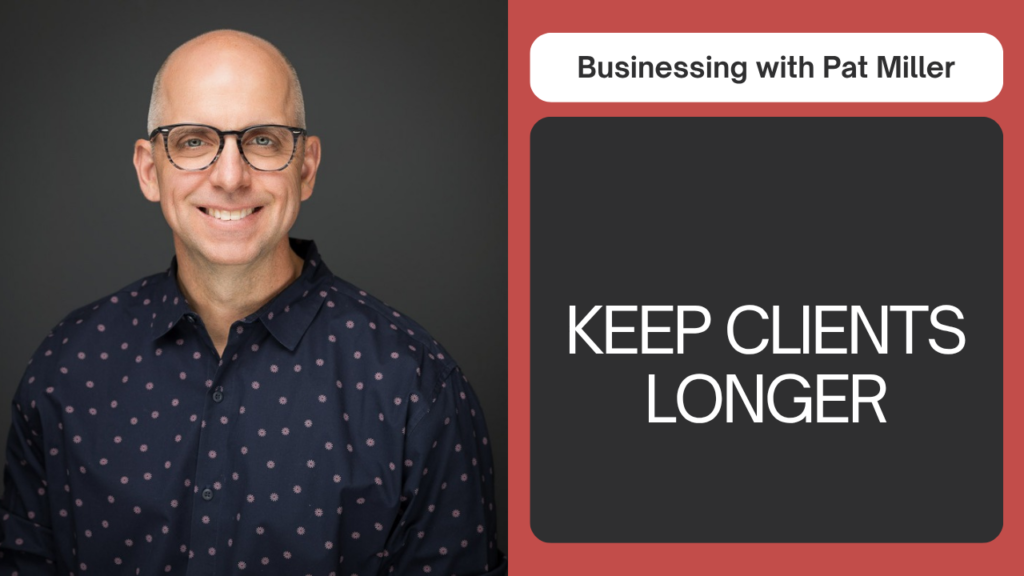
You get clients to stay longer by getting them the results you sold them, and then making sure they know they got them. Cards, gifts and anniversary notes are fine. None of them will save a client who is not getting what they paid for.
The question that came in was from an owner doing everything right on paper. Birthday cards, Christmas cards, a written recap of what they accomplished together, gifts on top of that. Clients kept leaving anyway. So let me shoot down the premise before I answer the question.
Why do not gifts and cards keep clients?
Because they are style points sitting on top of the thing that actually matters. You took money and you promised a result. If the result is not showing up, no amount of thank-you cards and gummy bears is going to change that math.
I have a lot of friends I do not give money to. I give money to people who get me results. Your clients work exactly the same way, and so do you.
Cards and gifts do have a job, and it is a narrow one. They help when a client is getting results but has lost sight of them. That is a communication problem, and a communication problem has a better fix than a gift basket.
What actually keeps a client?
Results, plus a system for reminding people they got them. Back when I was in the radio business, one of my mentors handed me the whole thing in one line: tell them what you are going to do, tell them when you are doing it, then tell them that you did it.
At the contract, it sounds like this. “We are going to get you three new clients by the end of the year. Let’s work together.”
Halfway through: “We have got two clients and a third one pending. We might hit your goal by November first instead of year end.”
At the end: “We promised three new clients by the end of the year. We got five. Great job by your sales team closing all those leads we brought you.”
Three touches, same promise every time. That is what turns a result into a renewal. And all of it is make-believe if you did not actually get them the clients, so start there.
Where do clients actually decide to leave?
Usually somewhere in a handoff, and usually well before you notice. Lisa Raebel walked the client experience timeline on the show, and it starts earlier than most owners think. Your marketing, before they even know you exist. The first intake call or email. The sales process. Onboarding. Delivery. Then continuation, where you ask for the upsell, the cross-sell, the referral, or the testimonial.
Every one of those steps has to be intentional. The timeline looks different in every company and every industry, but it is the same timeline, and the extra revenue is sitting in the gaps between the steps.
Her example from the show: a client of hers is changing accountants, because that accountant promised quarterly reviews and never called once all year. That is not a skill problem. That is the distance between what got sold and what got delivered.
How do you check your own client experience?
Two moves, and neither one costs you anything but nerve.
First, involve your team. List every person in your company who touches any step of that timeline. The receptionist taking the intake call is usually not the person running the sales conversation, who is usually not the person delivering the work. Walk a recent client’s path with all of them and ask where you were intentional and where you were winging it. Then take a client you lost and ask which part of the process lost them.
Second, ask your clients directly. Pick one of your best and ask where you could improve, and how it felt when they moved from sales over to delivery. Do not pick the ones who are your friends, because they will tell you that you are doing a great job whether you are or not. Lisa points people at a book called The Mom Test for exactly this reason.
That second one takes some courage. You are asking somebody who pays you to tell you where you are falling short, and you have to brace for the answer. If you are not asking, there is a reason underneath it, and that reason is worth being honest with yourself about before it costs you another client.
So here is the homework. Pick your newest client and write out their six steps with you, from marketing all the way to continuation. Circle the ones you are winging. Fix one of them this week.
Questions owners ask
Should I stop sending client gifts?
No. Just stop expecting them to do a job they cannot do. Gifts and cards are a nice touch on a relationship that is already working. They are not a retention strategy, and they will not cover for work that is not landing.
How often should I update a client on their results?
Three times minimum on any engagement. When you sign, at the midpoint, and at the end. State the same promise every time and measure against it. Most owners do the first one and skip the other two, then wonder why the renewal conversation feels cold.
Which clients should I ask for honest feedback?
Your best ones, and the ones you lost. Skip the clients who are also your friends. They are going to protect your feelings, which is kind of them and useless to you.
Where is the fastest place to find more revenue in my business?
In the gaps in your client experience, because you have already paid to acquire those people. Finding the step where you are improvising is cheaper than finding a new client, every single time.
Related
This one came from the Idea Slam on the Businessing episode for Monday, September 14, 2026, with guest Lisa Raebel. You can watch the full episode here.
Full episode with transcript: What to Say at a Networking Event: Businessing, September 14, 2026
Businessing is the daily live show where small business owners figure out what to do next. Hosted by Pat Miller, founder of the Small Business Owners Community: owners only, nobody pitching, $9 a month.